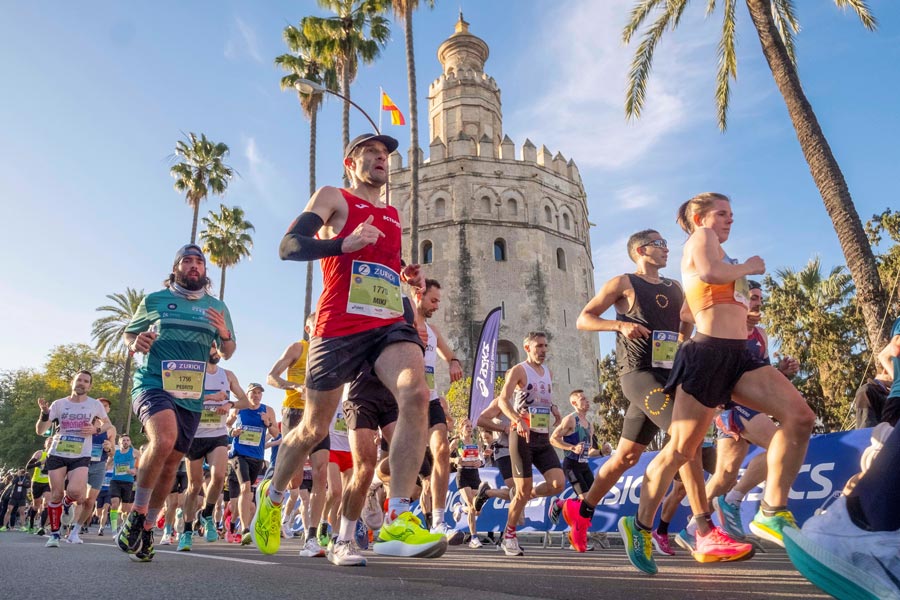
Maratón de Sevilla: análisis del circuito más plano de Europa
If you search Google for "marathon for a personal best," the algorithm will inevitably take you to Seville. But beware, if you read reports from three or four years ago, erase that information from your mind.
The Zurich Seville Marathon has mutated in its latest editions. It has left the exile of Isla de la Cartuja to bring the party to the heart of the city. We no longer finish doing laps on a soulless track; now the finish line is where Sevillian life beats.
As a runner who has lived through the transition from the old to the new course, I assure you the change is massive. The profile remains flat as a board (the flattest in Europe, in fact), but the mental strategy and logistics have changed radically.
In this analysis of almost 2,000 words, we are going to dissect the keys to the current course, that which starts and ends at Paseo de las Delicias, and I'll give you veteran tricks so you don't hit the wall on Kansas City Avenue.
The Big Change: Goodbye Stadium, Hello Center
The first thing you should know is that logistics have improved infinitely.
Before, getting to the start was an odyssey. Now, the start and finish are at Paseo de las Delicias, between María Luisa Park and the Guadalquivir River.
- Expert advantage: If you stay in the center (Santa Cruz neighborhood, Arenal, or around the Cathedral), you can go to the start walking. This is a luxury few Majors have. Being able to warm up by jogging gently for 15 minutes from your hotel to the starting corral eliminates 90% of pre-race stress.
Course Analysis
The new layout is a scalpel designed to cut through the wind and maintain pace. We are going to divide it into the new psychological phases.
Phase 1: Wide Start and the Cartuja (Km 0 to 12)
We start from Paseo de las Delicias. The avenue is very wide, which avoids the feared initial bottlenecks.
- The pace trap: The early kilometers take you towards the Barqueta Bridge and you cross to the Isla de la Cartuja (where we used to finish). It is an area of long straights and modern avenues.
- The danger: There isn't much crowd here. It is a cold and exposed area. It is easy to look at your watch, see you are going 5 seconds faster than planned, and think: "Today is my day." Mistake. Save that energy.
- Anecdote: In 2024, I saw a group trying to follow the 2:45h pacer in this area. They were bouncy. At kilometer 30, those same runners were walking. La Cartuja is for putting the pace to sleep, not for showing off.
Phase 2: The Asphalt Desert (Km 12 to 28)
Here we enter the north and east areas of the city (Macarena, Ronda Supernorte).
- Kansas City (Km 20-22): It remains the "boogeyman" of Seville. It is an endless avenue that seems to never end.
- The wind: If wind blows in Seville, here it will hit you head-on or from the side. It is vital that you find a "back" (a group).
- Veteran tip: In this new course, this central phase is the most monotonous. You have no monuments, just apartment blocks and asphalt. This is where you should put on "robot mode." Don't think. Just run. Eat your gels. Drink water.
Phase 3: The Approach (Km 28 to 34)
You approach the Sevilla FC stadium (Ramón Sánchez-Pizjuán) and the Nervión/Gran Plaza area. The crowd starts waking up. The streets narrow a bit more and you feel the human warmth.
- The turning point: Around Km 32-33, the race turns to return to the center. This is where you should do a systems check. If you have legs left, get ready, because the best is coming.
Phase 4: Monumental Ecstasy (Km 34 to 42)
The great success of the new course is concentrating the beauty at the end, when you need it most not to give up.
- Plaza de España (approx Km 34-35): This is unique in the world. The route goes literally inside the square. You run surrounded by regionalist architecture.
- Expert tip: The ground here changes briefly (hard earth/smooth cobblestones). Watch your ankles if you are very fatigued, but the energy of the place will make you float. It's the most "instagrammable" point of the race.
- Historic Center (Km 36-39): Avenida de la Constitución, the Giralda, the Cathedral. You are running through a pedestrian area full of screaming people. The echo in the narrow streets gives you goosebumps.
- Danger: The tram rails. On Avenida de la Constitución there are tracks on the ground. With the fatigue of km 38, we drag our feet. Lift your knees. I have seen dramatic falls 3 km from the finish by tripping on the rail.
The New Finish: Paseo de las Delicias
There is no longer a dark tunnel or stadium. Now you face the last 2 kilometers parallel to the river, with the Torre del Oro watching you.
The finish straight is long, very long, and visible from afar.
- Final wind: Being next to the river, sometimes there is a headwind in the last kilometer. But with people cheering at the fences, you won't even notice.
- The blue carpet: The tartan has been replaced by the famous blue carpet over the asphalt. Upon crossing the finish line, you have María Luisa Park right there to lie on the grass. Much better than the concrete stands of the stadium.
Specific Strategy for the New Course
1. The Curves
Although Seville is flat, the new passage through the historic center has some sharper 90-degree turns than the old Cartuja avenues.
- Tip: Don't cut through the sidewalk. First, because you can be disqualified (there are timing mats). Second, because the curb is the tired marathoner's natural enemy. Take turns wide.
2. GPS in the Center
Between Km 36 and 39, with narrow streets and tall buildings on Avenida de la Constitución, your GPS will go crazy. It will show absurd paces (2:30 min/km or 6:00 min/km).
- Key: Don't look at instantaneous pace in the center. Go by feeling or by official kilometer markers painted on the ground. If you try to adjust pace based on the crazy GPS in the center, you will burn out.
3. Starting Corrals
Being on Paseo de las Delicias, the corrals are very long.
- Logistics: If you want to go to the bathroom before starting, use the chemical toilets on the sides of the park before entering your corral. Once inside the starting "sleeve," it's hard to exit and return. Enter 20-30 minutes early; access can be slow due to the number of runners (currently around 12,000 – 14,000).
My Veteran Hacks for Seville
- Disposable clothing: Although the start is more central and "less cold" than the open field of the Cartuja, the river humidity at dawn is treacherous. Keep your old sweatshirt on until 2 minutes before the start.
- Breakfast: Being in the center, many cafes open early for companions, but you should have breakfast in your room. Don't risk looking for a spot at 6:30 AM on a Sunday.
- Post-Race: The new finish line leaves you near the restaurant area of the center and Triana.
- My recommendation: Cross the San Telmo bridge and go eat at Calle Betis in Triana. You'll be in the sun, with river views and the Torre del Oro, celebrating your time with a beer and a good plate of ham.
Conclusion: The Best Version of Seville
The course change has been a total success. It has turned a fast race into a race that is fast and beautiful.
You no longer have to choose between going for a time (Berlin/Valencia) or enjoying the city (New York/London). The new Seville Marathon gives you everything: avenues to fly and a touristic finish that thrills you when strength fails.
Respect the distance, watch out for the tram rails on Constitución, and above all, enjoy the entry into Plaza de España. Those 500 meters are worth all the preparation.
See you at Paseo de las Delicias.
Updated Summary (2023/2024 Data)
| Characteristic | Detail |
| Start / Finish | Paseo de las Delicias (Central) |
| Magical Point | Plaza de España (approx Km 34, you run inside) |
| Logistics | Excellent. Hotels within walking distance. |
| Profile | Flat (barely 10m gain), fewer sharp turns. |
| Hidden Danger | Tram rails (Km 37-38) and crazy GPS in center. |
| Wind | Key factor in the Kansas City area and next to the river. |
2 thoughts on “Maratón de Sevilla”